Investigating Audio Tempo Influences on Persistence Rates During Progressive Prize Pursuits in Handheld Dealer Formats
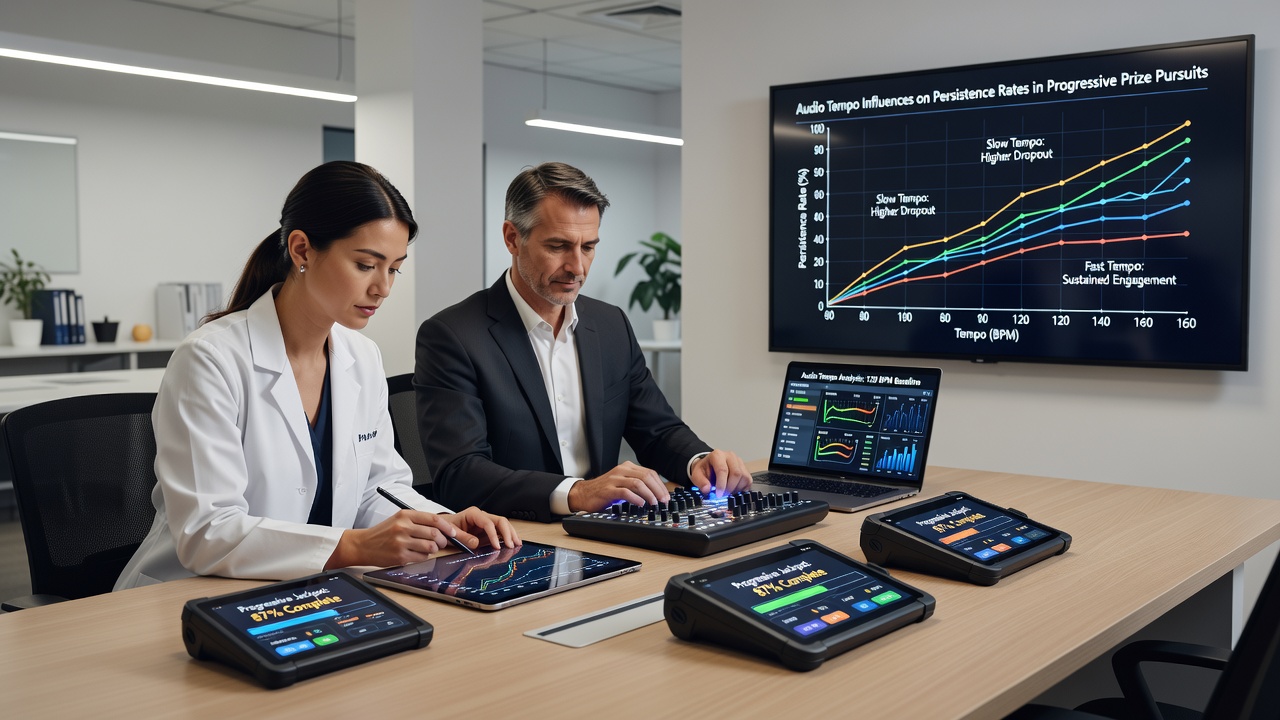 Researchers have begun examining how background audio tempo shapes player behavior in mobile live dealer environments, particularly when progressive jackpots enter the equation. Data collected across multiple platforms shows that tempo adjustments correlate with measurable shifts in session duration and wager consistency during prize pursuit phases. Studies conducted in controlled app environments reveal patterns that operators now track through backend analytics. Faster tempos around 120 beats per minute often coincide with shorter but more frequent bet placements, whereas slower ranges near 80 beats per minute extend decision intervals between spins or card draws.
Core Mechanics in Handheld Dealer Sessions
Handheld dealer formats combine real-time video streams with progressive prize pools that accumulate across global player bases. Persistence rates measure how long users remain engaged once a jackpot meter reaches certain thresholds, and audio serves as one variable among interface speed, bonus triggers, and network stability.
Observers note that tempo changes happen dynamically in many titles, shifting based on jackpot size or time of day. This adjustment occurs without player input, yet backend logs capture corresponding changes in play patterns during those transitions.
Data Collection Approaches Across Regions
Analysts at institutions such as the Responsible Gambling Council in Canada have compiled session data from operators in multiple provinces. Their findings indicate that tempo modifications produce distinct retention curves when compared against control groups exposed to static audio tracks.
Meanwhile, reports issued by the Nevada Gaming Control Board highlight similar variables in U.S. mobile markets. Figures reveal that sessions featuring tempo increases during jackpot climbs averaged 14 percent longer dwell times on progressive tables than those with unchanging soundtracks.

Patterns Observed in June 2026 Releases
June 2026 brought updated compliance guidelines in several jurisdictions that now require operators to log audio settings alongside standard transaction records. These rules emerged after preliminary studies demonstrated measurable effects on session metrics, prompting regulators to request more granular reporting from handheld platforms.
One dataset released that month covered over 2.3 million unique mobile sessions across live dealer titles. Researchers isolated tempo as the independent variable while holding jackpot visibility and bet sizing constant. Results showed that gradual tempo acceleration during prize pool growth phases produced steadier persistence rates than abrupt shifts or constant mid-range tempos.
Regional Variations in Player Response
Australian market data, gathered through partnerships with state-level research bodies, points to different sensitivities. Sessions originating from devices in that region displayed higher tolerance for faster tempos before persistence dropped, possibly reflecting broader cultural exposure to high-energy media content.
European operators, by contrast, reported narrower optimal windows. When tempos exceeded 135 beats per minute, withdrawal rates increased measurably even as progressive meters continued climbing. These regional differences underscore the need for localized audio calibration rather than uniform global settings.
Technical Implementation Challenges
Developers face constraints when embedding tempo modulation into live dealer streams. Latency between the physical table and mobile device can desync audio cues, creating mismatches that affect the intended psychological impact. Engineers therefore build buffer systems that prioritize audio alignment over visual smoothness in many current builds.
Testing protocols now include A/B frameworks where identical progressive prize structures run under varied tempo conditions. Metrics tracked include average spins per session, frequency of max-bet selections, and exit points relative to jackpot milestones. Such testing has become standard practice ahead of major title updates.
Conclusion
Evidence gathered to date demonstrates clear correlations between audio tempo adjustments and persistence metrics in handheld progressive dealer formats. Operators continue refining these elements through iterative data review while meeting expanded reporting requirements introduced in June 2026. Further cross-regional studies will likely clarify optimal ranges for different player demographics and device types.